Cathedral Challenge / 001 · Living research record
Testing the PX1 signal.
Keeping the unknowns visible.
Can Cathedral independently reproduce the reported PX1/PIN antimalarial-resistance signal in Uganda and test its detection across public African Plasmodium falciparum genomic data, while quantifying its relationship with known K13 markers and identifying the highest-value next experiment?
Current bounded-attempt verdict
INSUFFICIENT PUBLIC ARTIFACTS
The inspected author release lacks three files required by its phenotype model. Cathedral executed an independent genotype-artifact inspection, then reran it with identical output. The reported phenotype association and Africa-wide signal have not been reproduced. Availability of model inputs outside this release remains unresolved.
A later source check, documented below, located per-isolate phenotype and haplotype data at the publisher. It advances input recovery without changing this earlier execution record. The complete original-model bundle is not yet qualified.
What was actually executed
A Python standard-library program inspected the released example VCF at three specified PX1 SNP positions, preserved mixed calls separately, and matched the author’s K13 metadata by sample ID. No upstream R code, generated code or wet-lab procedure ran.
- VCF samples
- 211
- Metadata matches
- 211
- Exit code
- 0
- Clean rerun
- Identical output
COMPUTATIONAL OBSERVATION — NOT INDEPENDENTLY VALIDATED
- all three alt present unphased: 8 samples
- all three pure alt: 106 samples
- other complete: 97 samples
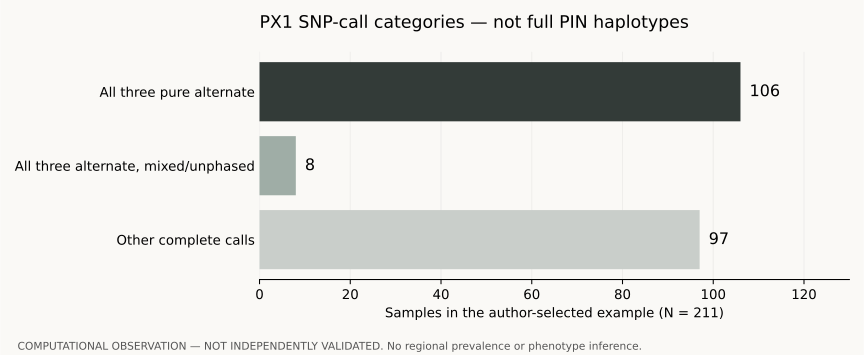
These counts describe an author-selected example. They are neither PIN haplotype prevalence nor an estimate of resistance prevalence. The defining deletions, phase and phenotype are not established by this inspection.
Research timeline
- 2026-10-08T17:53:59.552085+00:00 · UTC
Formal public-artifact inspection started with the pinned author release and recorded inputs.
- 2026-10-08T17:54:07.039042+00:00 · UTC
Inspection completed, exit 0, 7487 ms. The central model remained blocked at input validation.
- Separate process reruns returned byte-identical output. Their scope was artifact inspection, not the phenotype model.
- Next: recover model inputs and independently verify haplotype definitions before extending to other African datasets.
Primary evidence, code & data
The scientific interpretation remains attached to the primary record and its supplied artifacts.
- Primary paper · DOI 10.1038/s41591-026-04590-5
- Author’s archived code and example data · 10.5281/zenodo.21283869
- Pinned author repository · MIT license
Missing inputs in the inspected release
- ex_vivo_phenotype_data_long_table_current.csv
- parasitemia.csv
- COI_calls_all_uganda_samples.csv
The local R runtime was also unavailable. Installing R alone would not supply the missing phenotype and covariate data.
Available experiment inputs
Source check recorded (UTC). This is a dated input catalogue, not a live availability guarantee or another experiment result.
- Main-paper source data located. The publisher-linked source workbook has sample names, haplotypes, drug-response fields and parasitemia. Of the 211 example sample names, 161 match exact text keys; one numeric sample key remains unmapped. Its 1,347 physical rows include a header, not a qualified analysis denominator. COI is not a named column in this sheet; wsaf has not been substituted for it. Data-specific reuse permission and the complete model cohort remain unverified. Article terms: CC-BY-NC-ND 4.0.
- Earlier phenotype source located. The published source workbook contains seven sheets, including a data dictionary and drug-response tables. Its UID columns and parasitemia percentage unit are inspectable. The per-isolate join to this PX1 analysis is not yet established. Source paper and reuse terms.
- Pinned author inputs checked. The exact repository tree contains the model script and the 211-row example metadata. The three named model-input CSVs are absent from that tree; this does not prove they are unavailable elsewhere. The script was not executed by this source check.
- PRJNA1298911 (WGS). 158 deposited runs, 158 distinct sample accessions; 465,882,029,469 known FASTQ bytes. Every run has a listed FASTQ. Inspect provider manifest. Raw reads have not been downloaded.
- PRJNA1450510 (AMPLICON). 1,375 deposited runs, 1,375 distinct sample accessions; 6,124,279,733 known FASTQ bytes. 71 runs have no listed FASTQ; the byte total is incomplete. 546 records have no species label in this report. Inspect provider manifest. Raw reads have not been downloaded.
- Pf7 comparison metadata checked. 20,864 distinct samples across 33 known countries. Known collection years: 1984–2018; 160 rows have no parsed year. The provider’s QC-pass field is true for 16,203 rows, not proof of suitability for this analysis. Its MD5 matched the provider checksum. Genotypes, PIN calls and a compatible cohort have not been established. Pf7 release and licence.
Inspect source receipts and remaining inputs
- Data Set 1: 1,113 distinct UID strings; 32 exact matches against the 211 example sample names. No key rewriting or biological join was performed.
- Data Set 2: 1,615 distinct UID strings; 35 exact matches against the 211 example sample names. No key rewriting or biological join was performed.
- Data Set 3: 1,776 distinct UID strings; 40 exact matches against the 211 example sample names. No key rewriting or biological join was performed.
- Data Set 4: 665 distinct UID strings; 23 exact matches against the 211 example sample names. No key rewriting or biological join was performed.
- Data Set 5: 1,568 distinct UID strings; 35 exact matches against the 211 example sample names. No key rewriting or biological join was performed.
- Verify the exact per-isolate join between the published phenotype source and PX1 genotypes; do not join by row order or collection year.
- Recover and qualify COI calls and the exact parasitemia transformation expected by the pinned model.
- Validate full PIN/deletion/phase definitions and cohort inclusion, not only the three example SNPs.
- Confirm data-specific reuse/access terms and preregister a bounded input bundle before isolated execution.
Workbook rows include headers and are not automatically isolate counts. The original execution capsule and verdict above remain unchanged. No sequencing download or paid compute is triggered by opening this page.
Open machine-readable input catalogueCatalogue SHA-256: 3db6cde36b028ce17404c3d9a09ecb1156457a0d899d1bdcb2a70adf59315013
This digest checks the exported catalogue, not an external timestamp or scientific validation.
Claim ledger & critic
Observed: the three target SNP records occur in the supplied example VCF, with 211 samples matched to the supplied metadata. Inspect the capsule for calls, hashes and methods.
Not established: a complete PIN haplotype, drug-response effect, independent relationship with K13, clinical treatment failure, or geographic spread.
Critic verdict: REJECT SCIENTIFIC GENERALIZATION. Selected example genotypes cannot establish drug resistance, an independent PX1 effect, or regional prevalence. Missing phenotype/covariate inputs prevent the central model reproduction.
No new scientific collision or Ghost Node has been validated from this attempt.
The next useful experiment
- Computational: validate the full haplotype including deletions and mixed-infection handling, then rerun the author’s specified model in a pinned environment once exact phenotype/covariate inputs are recovered. This addresses a prerequisite before extending the signal geographically.
- Additional data: locate the missing per-isolate model inputs and data dictionary, resolve cohort inclusion criteria, and establish access/usage conditions for public African genomic cohorts and resistance metadata.
- Wet-lab plan: after computational review, design an approved isogenic genotype comparison that controls K13 background and measures assay-specific drug response. This is a proposal requiring domain expertise and institutional review; Cathedral will not actuate it.
These priorities are an artifact-availability assessment, not estimated information-gain scores. Costs, runtime, feasibility and biological discriminators remain unmeasured.
Limitations & provenance
- The VCF is an author-selected example, not a representative African cohort.
- Three SNPs do not establish the full PIN haplotype; the two defining deletions and infection-level phase are not assessed.
- No genotype quality or depth threshold was applied beyond retaining the source VCF calls; mixed and missing calls are separate categories.
- K13 labels are author-supplied metadata, not independently genotyped in this analysis.
- No phenotype data, adjusted effect size, clinical outcome or causal interpretation was generated.
- No comparison to MalariaGEN or other African public cohorts was performed.
Inspect the execution record
{
  "provider": "local-python",
  "tool": "public-artifact-probe",
  "version": "001-public-artifact-probe-v1",
  "startedAt": "2026-10-08T17:53:59.552085+00:00",
  "completedAt": "2026-10-08T17:54:07.039042+00:00",
  "durationMs": 7487,
  "exitCode": 0,
  "command": [
    "python",
    "challenges/001/code/probe_public_artifacts.py",
    "--vcf",
    "/workspace/scratch/feaa98d57d36/challenge-work/uganda.vcf.gz",
    "--metadata",
    "/workspace/scratch/feaa98d57d36/challenge-work/upstream/Examples (selection)/px1_genotypes_metadata_combined.tsv",
    "--upstream",
    "/workspace/scratch/feaa98d57d36/challenge-work/upstream",
    "--output",
    "/tmp/cthdrl-challenge-formal-attempt.json"
  ],
  "stdout": "{\"verdict\": \"INSUFFICIENT PUBLIC ARTIFACTS\", \"samples\": 211, \"matchedMetadata\": 211, \"missingInputs\": [\"ex_vivo_phenotype_data_long_table_current.csv\", \"parasitemia.csv\", \"COI_calls_all_uganda_samples.csv\"]}\n",
  "stderr": "",
  "outputSha256": "54363549b20ab97e6794b1d6c01a795102d735e628d01c260a80f17216f6edd3",
  "cleanRerun": {
    "executed": true,
    "identicalOutput": true,
    "scope": "Independent artifact inspection only; not a rerun of the missing phenotype model"
  },
  "repository": "https://github.com/Khufu2/cthdrl",
  "upstreamRepository": "https://github.com/Karaniare/PfWGS-DRscanner",
  "upstreamCommit": "8ef861e27f93d95859113003dc01d24747fb28c7",
  "upstreamArchiveDoi": "10.5281/zenodo.21283869",
  "upstreamLicense": "MIT",
  "paperDoi": "10.1038/s41591-026-04590-5",
  "primaryModelExecuted": false,
  "unknowns": [
    "Actual PIN haplotype including deletions",
    "Availability of additional model inputs outside the inspected release",
    "Independent K13 genotypes",
    "African cohort representativeness",
    "Phenotype effect sizes"
  ],
  "figures": [
    {
      "name": "snp-call-categories.svg",
      "sha256": "d999a0e2a22b1c551239d872073407d8f913025a76cac0e4f34f1753aa09f63d",
      "generator": "matplotlib",
      "version": "3.10.8",
      "scope": "Descriptive counts from the recorded selected example, not regional prevalence"
    }
  ]
}
This is research software and a bounded computational inspection, not patient treatment advice.